
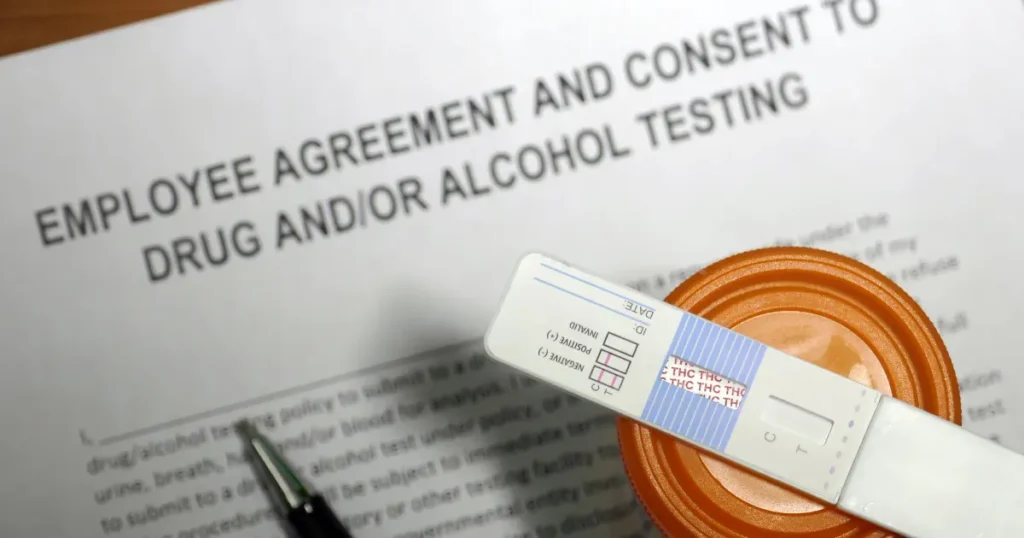
Most private employers can drug test. Most can fire you for a positive result. What they cannot do, when they can test, and what your options are depends on your state, your industry, and the specific job. Understanding the mechanics before you apply — or before you are called in for a test — is the decision point.
This page covers non-DOT employment drug testing. If you hold a CDL or work in a DOT-regulated safety-sensitive position, federal rules apply instead. See CDL Drug Testing Rules: What Felons Must Know.
What Employers Can Legally Do
Private employers in most states have broad authority to require drug testing as a condition of employment and continued employment. Federal law does not restrict private employer drug testing for non-safety-sensitive positions. State law creates the limits — and state law varies significantly.
Pre-employment testing: Legal in all 50 states for private employers. Most employers test after a conditional job offer — not before. Failing a pre-employment test typically results in withdrawal of the offer. Most employers do not explain why. Most do not give second chances.
Random testing: Legal in most states for private employers, particularly in industries with safety components. Frequency and notice requirements vary by state. Some states require that random selection be genuinely random and documented. Some restrict random testing to safety-sensitive roles even for private employers.
Reasonable suspicion testing: Legal everywhere. Employers can require testing when a supervisor observes behavior suggesting impairment — appearance, speech, coordination, smell. The observation typically needs to be documented. This is the most common testing trigger for existing employees.
Post-accident testing: Legal in all states. Standard practice after workplace injuries, property damage, or incidents involving safety equipment. Refusal to test after an accident is treated as a positive result by most employers and may affect workers’ compensation claims.
Return-to-duty testing: If you failed a test and were retained, most employers require clean testing before returning. Terms vary by employer policy.
State Law Limits
A growing number of states restrict how employers can use marijuana test results specifically. These protections are newer and vary widely — knowing your state’s current rules matters.
States with stronger marijuana employment protections: California, New York, New Jersey, Illinois, and several others have laws limiting employer ability to take adverse action based on off-duty marijuana use alone. These laws typically do not apply to safety-sensitive positions or federally regulated jobs.
States with minimal marijuana employment protections: Most of the South and many Midwest states give employers broad discretion to test for and act on marijuana use regardless of state legalization status.
What this means practically: Even in legal states, employers retain the right to maintain drug-free workplace policies and terminate based on positive tests in most circumstances. Legal marijuana use does not guarantee employment protection. Verify your specific state’s current law — these rules have changed frequently since 2020.
What Employers Test For
Standard private employer testing typically uses a 5-panel screen: marijuana (THC), cocaine, amphetamines, opiates, and PCP. Many employers use 10-panel tests that add benzodiazepines, barbiturates, methadone, propoxyphene, and Quaaludes. Some industries add alcohol.
Urine testing is most common for pre-employment. Oral fluid (saliva) testing is increasingly used for reasonable suspicion and random testing because collection is observed and results are faster. Hair follicle testing, which detects use up to 90 days back, is used by some employers for pre-employment screening in higher-security roles.
Detection Windows by Substance
These are general ranges. Actual detection depends on frequency of use, metabolism, body composition, and lab detection thresholds. They are not planning tools — they are the reason people get caught when they thought they were clear.
| Substance | Urine Detection Range |
|---|---|
| Marijuana (THC) — casual use | 3–7 days |
| Marijuana (THC) — daily use | 30–60 days or longer |
| Cocaine | 2–4 days |
| Amphetamines/Meth | 3–5 days |
| Opiates (heroin, morphine) | 2–3 days |
| Benzodiazepines — single use | 3–7 days |
| Benzodiazepines — chronic use | Up to 30 days |
| Alcohol | 12–24 hours (ETG test up to 80 hours) |
Labs run confirmation tests on borderline results. “Almost negative” still reports as positive. Dilute samples — caused by drinking excessive water — flag automatically and are often treated as positive or require immediate retest under observation.
What Happens If You Fail
Pre-employment failure: Job offer is withdrawn. Most employers do not notify you of the reason. No legal obligation to tell you. No formal appeals process. Some employers impose a waiting period before you can reapply — typically 6–12 months. Most do not.
Failure as a current employee: Termination in most cases. Some employers — particularly unionized workplaces or those with formal EAP (Employee Assistance Program) policies — may offer a last-chance agreement that requires treatment and clean testing to return. These agreements are employer discretion, not legal requirements.
Rehire eligibility: A failed test at one employer does not create a shared database the way the DOT Clearinghouse does for CDL drivers. Private employer drug test results are not reportable to other employers. A failed pre-employment test at one company does not appear in background checks at the next. It may show up in employer references if your previous employer discloses the reason for termination.
Prescription Medications
Valid prescriptions provide some protection but not automatic protection. If you test positive for a controlled substance covered by a prescription, disclose the prescription to the Medical Review Officer or HR before or immediately after testing — not after you receive the result. Disclosure after the fact appears evasive.
Employers retain the right to determine whether a prescription creates safety concerns for the specific role. Opioid prescriptions for physically demanding or machinery-operating positions may still result in disqualification during active use. ADHD medications are generally accepted with documentation.
If You Are Also Under Probation or Parole
A failed employer drug test does not automatically trigger a probation or parole violation — unless your conditions specifically require reporting job termination or positive tests. But termination may create instability your officer documents. Employment gaps trigger questions. Questions create documentation. Consistent employment is one of the strongest signals a supervision file can show.
For how drug testing works under active supervision, see Drug Testing for Probation & Parole. For the full supervision compliance system, see Supervision Compliance Guide.
Bottom Line
Most employers can test. Most can terminate for a positive result. State marijuana protections exist in some states but are narrower than most people assume. Private employer test results do not follow you to the next employer through a shared database — which is meaningfully different from the CDL Clearinghouse system.
The decision point is before you apply, not after the test is called. Know what the job tests for, know your state’s current rules, and make the calculation before it is made for you.