
Stop Asking for Permission. Start Invoicing.
Here’s what nobody tells you about having a record: You don’t need an employer’s approval to make money.
Every job application with that checkbox is another person deciding your worth based on your worst day. Every background check is another gatekeeper between you and a paycheck. Entrepreneurship changes the equation completely.
When you own the business:
- No background checks
- No explaining your past to HR
- No waiting for someone else to give you a “second chance”
- You set your own income ceiling
This isn’t motivational nonsense. This is the practical reality that tens of thousands of formerly incarcerated people have proven: Your record doesn’t matter when you’re the one signing the checks.
The businesses in this guide require $0 to $5,000 to start, use skills you already have or can learn in days, and have proven income potential in the $40K-$150K range. Some you can start this afternoon.
Let’s get you paid.
The Bootstrap Business Comparison: 7 Real Options
| Business Type | Startup Cost | Year 1 Income Potential | Difficulty | Why It’s Felon-Friendly |
|---|---|---|---|---|
| Window Cleaning | $100-$500 | $40k-$80k | Low | No license required; customers care about results, not your background |
| Landscaping | $1,000-$3,000 | $50k-$100k | Medium | Massive demand; homeowners care if grass gets cut |
| Junk Removal | $2,000-$5,000 | $60k-$120k | Medium | Just need truck/trailer; perfect for physically strong people |
| Hot Shot Trucking | $15,000-$30,000* | $80k-$150k+ | High | No CDL needed (under 10k lbs); high demand for fast delivery |
| Digital Marketing | $0-$200 | $30k-$150k+ | High | Complete anonymity online; measured only on ROI |
| Mobile Detailing | $500-$2,000 | $45k-$90k | Low-Medium | Customers care about clean cars, not background |
| Pressure Washing | $1,500-$4,000 | $50k-$100k | Medium | Recurring commercial contracts available |
*Hot shot can be bootstrapped by leasing vehicle instead of buying cash
Window Cleaning – The Same-Day Money Business
Why this works: You can buy equipment at 9am and have cash in your pocket by 3pm. No licensing in most states. Homeowners and small businesses need this monthly.
What You Need to Start
Essential equipment ($100-$300):
- Squeegee and extension pole ($40)
- Bucket and scrubber ($20)
- Cleaning solution ($15)
- Ladder (borrow or buy used, $50-$150)
- Business cards from Vistaprint ($20)
That’s it. You can start with less than $200.
How to Get Your First Customers
- Door-knock residential neighborhoods on Saturday mornings. Offer to do first-floor windows for $50. When they see the results, upsell the whole house ($150-$300).
- Target storefronts. Small retail shops need monthly window cleaning. Quote $80-$150/month for weekly service.
- Recurring revenue is the goal. One client paying $100/month = $1,200/year from a single sale.
The Math
Residential route (20 houses at $150 each, monthly):
- 20 houses × $150 = $3,000/month
- Clean 4-5 houses per day
- Work 3-4 days/week = $36K-$48K/year
Add commercial accounts (5 storefronts at $120/month):
- 5 × $120 = $600/month additional
- Total = $3,600/month = $43K/year
Scale by hiring: One employee can handle the route while you sell. Suddenly you’re at $80K+.
What this video shows — without the hype
Nick walks through a simple, low-cost way to start window cleaning: basic tools from Home Depot, door-to-door sales, and focusing on neighborhoods where people can afford maintenance. The core idea is realistic — you can start for around $50–100, learn quickly, and get paid the same day. The hard part isn’t equipment; it’s handling rejection and showing up consistently.
Reality check from SCG
- Income varies by city and season — $500/day is possible, not automatic
- Door-to-door is uncomfortable at first
- You’ll need insurance and a plan as you grow
- Quality and reliability matter more than sales scripts
Get the Free Window Cleaning Guide
No background checks. No licenses. Same-day pay. Step-by-step plan to your first $1,000 with $50 in tools.
- 14-day action plan
- door script
- real pricing
- field checklists
Landscaping – Sweat Equity Goldmine
Why this works: Everyone with a yard needs this. Demand is endless. You’re selling a result (nice lawn), not your story.
What You Need to Start
Bare minimum ($1,000-$1,500):
- Push mower (buy used on Craigslist, $150-$300)
- String trimmer ($100-$200)
- Edger ($80-$150)
- Blower ($60-$100)
- Rake, shovel, basic hand tools ($50)
- Trailer or truck bed to haul equipment
Professional setup ($2,500-$3,000):
- Commercial-grade mower ($800-$1,500)
- All the above tools
- Enclosed trailer (buy used)
The Business Model
Residential maintenance:
- Mow, edge, blow = 30-45 minutes per yard
- Charge $35-$60 per visit
- Weekly service = $140-$240/month per customer
The route model:
- 25 weekly customers at $50/visit = $1,250/week
- 4 weeks = $5,000/month = $60K/year
- Work 8 months (April-November in most climates)
Where the real money is:
- Mulching and landscaping installs: Charge $500-$2,000 for a weekend project
- Commercial properties: Apartment complexes and HOAs pay $500-$2,000/month for grounds maintenance
- Snow removal in winter (if you’re in cold climates)
Getting Customers Fast
- Nextdoor app: Post in local groups offering spring cleanup specials
- Drive the neighborhoods: Leave flyers on doors in nice subdivisions
- Underbid the big guys: LawnStarter and TruGreen charge $80-$100. You charge $50. You’ll be booked in weeks.

Junk Removal – The Truck-Based Cash Machine
Why this works: 1-800-GOT-JUNK franchises cost $100K+ to start. You can do the exact same thing independently for under $5K.
What You Need
Minimum viable setup ($2,000-$3,000):
- Pickup truck or cargo van (already have one? You’re halfway there)
- Trailer ($500-$1,500 used)
- Tie-down straps, dolly, work gloves ($200)
- Dump fees (pay as you go, $30-$80 per load)
Optional but helpful:
- Dump trailer with hydraulic lift ($3,000-$5,000)
- Helps you work solo instead of needing a helper
Two Revenue Streams
1. Residential jobs (one-time cleanouts):
- Estate cleanouts, garage/basement clearing, foreclosure cleanup
- Charge $150-$500 per job depending on volume
- Post on Craigslist, Facebook Marketplace, Nextdoor
2. Commercial recurring contracts (where the real money is):
- Construction companies need dumpsters emptied weekly
- Property managers need tenant move-out junk removed
- Retail stores need old inventory hauled
- Charge $400-$1,000/month per contract
The Math
Mix of residential and commercial:
- 8 residential jobs/month at $300 each = $2,400
- 3 commercial contracts at $600/month = $1,800
- Total = $4,200/month = $50K/year
Scale by adding a second truck/crew: Now you’re at $100K+.
Pro Tip: Reselling and Recycling
Smart junk haulers don’t just dump everything. They:
- Sell scrap metal (appliances, AC units, copper wire)
- Resell furniture on Facebook Marketplace
- Donate items for tax write-offs
This can add $500-$1,500/month in extra income.
Hot Shot Trucking – High Income for Drivers
Why this works: Hot shot trucking is the “Uber for freight.” Companies need small, urgent loads moved fast. You can earn $80K-$150K+ with no CDL required.
What Is Hot Shot Trucking?
Traditional trucking:
- Requires Commercial Driver’s License (CDL)
- Semi-trucks hauling 40,000+ lbs
- Long-haul routes, weeks away from home
Hot shot trucking:
- No CDL needed if under 26,000 lbs GVWR (Gross Vehicle Weight Rating)
- Pickup truck + flatbed or gooseneck trailer
- Short-to-medium hauls (100-500 miles)
- Urgent deliveries (construction equipment, auto parts, oil field supplies)
What You Need
Vehicle options:
- 3/4-ton or 1-ton pickup (Ford F-350, Ram 3500, Chevy 3500)
- Gooseneck or flatbed trailer rated for 10,000-14,000 lbs
- Total investment: $15,000-$30,000 (can lease to reduce upfront cost)
Required items:
- DOT number (free to register)
- Motor Carrier (MC) number ($300)
- Commercial auto insurance ($3,000-$8,000/year depending on state)
- Load securement equipment (straps, chains, binders: $500)
How You Get Loads
Load boards connect you to jobs immediately:
- DAT Load Board (industry standard, $200-$400/month subscription)
- uShip (post your truck, customers bid on you)
- Central Dispatch (popular for auto transport)
Typical loads:
- Construction equipment to job sites
- Oil field parts in Texas, Oklahoma, North Dakota
- Auto parts for dealerships
- Machinery for factories
The Income Potential
Per-mile rates: $1.50-$3.00 per mile depending on urgency and cargo
Example week:
- Load 1: 300 miles at $2/mile = $600
- Load 2: 450 miles at $1.75/mile = $787
- Load 3: 200 miles at $2.50/mile = $500
- Total = $1,887/week = $7,500/month = $90K/year
Expenses to factor:
- Fuel (~30% of revenue)
- Truck/trailer payments
- Insurance
- Maintenance
Net after expenses: $60K-$100K+ depending on how hard you hustle.
Reality Check
This is the hardest business on this list to start because:
- Higher upfront cost
- Requires driving long hours
- Truck breakdowns = no income
But if you already have a truck and like driving, this is the fastest path to six figures.
What this video shows
Michael breaks down a realistic path into hotshot trucking startup costs without huge debt: start with a used pickup, gain road experience, and build equipment step-by-step. He explains that non-CDL hotshot setups are possible under 26,001 lbs GVWR, while a CDL can open access to heavier loads and better rates. You don’t need a $100k rig — many drivers start closer to $40–50k total investment, with first-year hotshot insurance as the biggest expense. The key takeaway: you can enter hotshot trucking in months, not years, with smart planning instead of heavy credit.
Digital Marketing – Skills Over Records, Anonymity Over Background Checks
Why this works: Your clients never meet you. They never see your record. They only see results. If you drive them sales, they pay you. Period.
What You Can Sell (With Zero Experience Required)
1. Local SEO for small businesses
- Help plumbers, roofers, lawyers rank on Google
- Charge $500-$2,000/month per client
- Learn the basics in 2-4 weeks (free YouTube courses)
2. Facebook/Instagram ads for e-commerce
- Run ads for online stores
- Charge percentage of ad spend (10-20%) or flat $1,000-$3,000/month
- Meta Blueprint (free certification) teaches you everything
3. Content creation and social media management
- Post daily content for local businesses
- Charge $500-$1,500/month per client
- Use Canva (free) and ChatGPT to create posts
4. Virtual assistant services
- Email management, calendar scheduling, data entry
- Charge $20-$40/hour or $1,500-$3,000/month retainer
- Get clients on Upwork, Fiverr, or directly through LinkedIn outreach
What You Need to Start
Literally nothing but a laptop and internet:
- Computer (library computers work if you don’t have one)
- Free tools: Canva, Google Workspace, ChatGPT
- Optional: $50-$100/month for paid tools (SEMrush, Later, Hootsuite) once you land clients
How to Get Your First Client
The free audit strategy:
- Find 20 local businesses with bad Google reviews or no social media presence
- Create a free audit showing what’s broken (use ChatGPT to help)
- Email/DM them: “I noticed your Google listing has 3-star reviews and your competitor has 4.5. I can help you fix this for $500/month. Here’s a free audit.”
- Close 1 in 10 = 2 clients = $1,000-$2,000/month
Scale by niching:
- Focus on one industry (chiropractors, roofers, med spas)
- Build case studies showing results
- Charge $2,000-$5,000/month once you prove ROI
The Income Path
- Months 1-3: Hustle for first 2-3 clients at $500-$1,000/month = $1,500-$3,000/month
- Months 4-6: Raise rates, add 2 more clients = $5,000-$8,000/month
- Month 12: 8-10 clients at $1,500/month average = $12,000-$15,000/month = $150K/year
This is the highest-ceiling business on this list. No one cares about your background when you’re making them $20K/month in revenue.

Mobile Detailing – The Weekend Side Hustle That Scales
Why this works: Every car owner wants a clean car. You go to them. Low overhead, high margins, instant cash.
What You Need
Basic setup ($500-$1,000):
- Pressure washer ($150-$300)
- Shop vac ($80-$150)
- Microfiber towels, brushes, buckets ($100)
- Quality car soap, wax, interior cleaner ($150)
- Water tank (5-gallon jugs or 50-gallon tank in truck, $50-$200)
Professional setup ($1,500-$2,000):
- Portable water tank and generator
- Commercial-grade extractor for deep cleaning
- Ceramic coating supplies (upsell service)
Pricing Structure
Exterior wash and wax: $50-$80 Interior detail: $80-$150 Full detail (inside + outside): $150-$250 Add-ons: Ceramic coating ($300-$600), headlight restoration ($50-$100), engine bay cleaning ($50)
The Business Model
Weekend warrior approach:
- Detail 6-8 cars per weekend at $150 average
- $900-$1,200/weekend = $3,600-$4,800/month = $45K-$58K/year
Go full-time:
- Detail 3-4 cars/day, 5 days/week
- 15 cars/week × $150 = $2,250/week = $9,000/month = $108K/year
Corporate contracts = recurring revenue:
- Car dealerships need lot cars detailed weekly
- Rental car companies (Enterprise, Hertz) outsource detailing
- Charge $40-$60 per car, 20-50 cars/week = steady $800-$3,000/week
In this video, Kevin Liu explains how he transitioned from a traditional insurance job into a mobile detailing business started with a few hundred dollars. He breaks down real startup costs, early mistakes, and how recurring customers and upsells helped him replace his 9–5 income within months. While the video is optimistic, it offers a realistic look at how service businesses can scale when demand, consistency, and customer service are handled correctly.
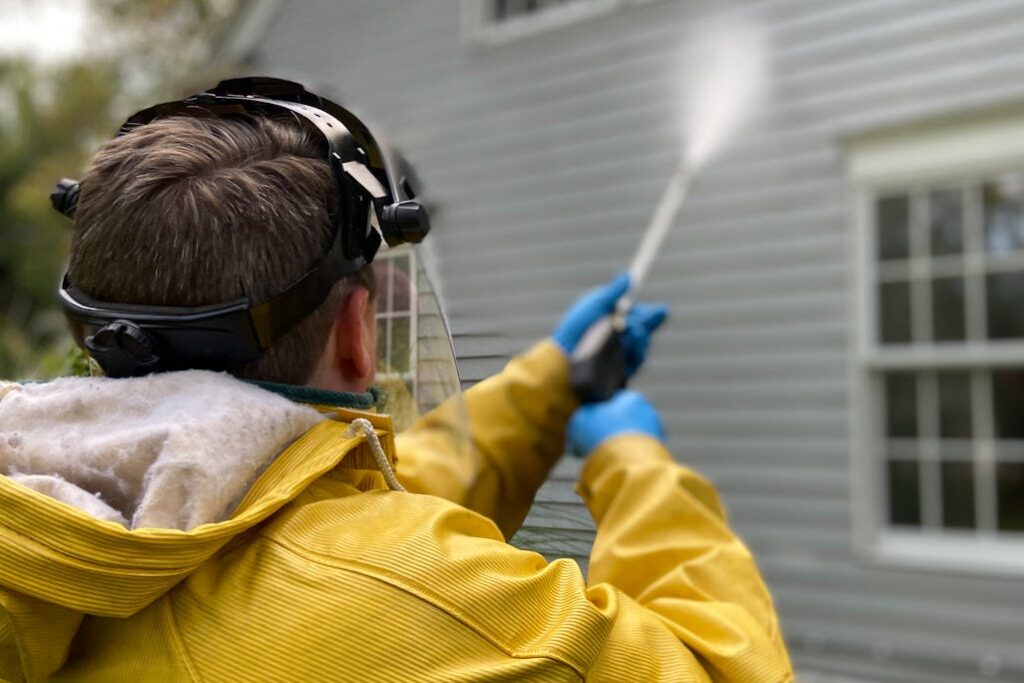
Pressure Washing – Recurring Revenue Machine
Why this works: Driveways, sidewalks, building exteriors get dirty every year. Businesses need this quarterly. Recurring revenue builds fast.
What You Need
Entry-level setup ($1,500-$2,500):
- 3,000-4,000 PSI gas pressure washer ($400-$800)
- Surface cleaner attachment ($150-$300)
- Extension wands, nozzles, hoses ($200)
- Business cards, local ads ($100)
Professional setup ($3,500-$5,000):
- Commercial 4,000+ PSI trailer-mounted unit
- Hot water capability (cuts cleaning time in half)
- Multiple wands and surface cleaners
Pricing Guide
Residential:
- Driveway: $100-$200
- House exterior: $200-$400
- Deck/patio: $150-$300
Commercial:
- Storefront sidewalks: $75-$150 (monthly contracts)
- Parking lots: $300-$1,000 (quarterly contracts)
- Building exteriors: $500-$2,000
The Recurring Revenue Strategy
This is where pressure washing beats one-time services:
- Sign 10 commercial clients at $100/month for monthly sidewalk cleaning = $1,000/month baseline
- Add 20 residential driveways at $150 each (annual cleaning) = $3,000 in spring rush
- Add 5 parking lot contracts at $400/quarter = $1,600 every 3 months
Year 1 realistic income: $50K-$70K Year 2 with 30+ recurring clients: $80K-$100K+
Getting Legal: The Boring but Vital Stuff
You can start making money today and handle this later—but don’t wait longer than 30 days.
Business Structure: LLC vs. Sole Proprietorship
| Sole Proprietorship | LLC | |
|---|---|---|
| Cost | $0 (just use your name) | $50-$500 depending on state |
| Liability | You’re personally liable for debts/lawsuits | Business is separate legal entity |
| Taxes | Report on personal tax return | Can choose how you’re taxed |
| Best for | Testing the idea with under $10K revenue | Anything you’re scaling seriously |
Recommendation: Start as sole proprietor. Once you’re making $2K+/month consistently, form an LLC.
Getting Your EIN (Employer Identification Number)
What it is: Your business’s social security number. Required to open a business bank account and hire employees.
How to get it: Free at IRS.gov. Takes 10 minutes online. Your criminal record does not disqualify you.
Opening a Business Bank Account
Why you need one:
- Separates personal and business money (critical for taxes)
- Looks professional when clients pay you
- Required if you form an LLC
Your record won’t stop you from getting a business account. Banks care about your business’s credit, not your personal background.
Easiest banks for business accounts:
- Novo (online bank, instant approval)
- Relay (designed for small businesses)
- Local credit unions (more lenient than big banks)
[Link to your banking resources page here]
Business Insurance: The Myth vs. Reality
The myth: “I can’t get insurance with a felony.”
The reality: General Liability Insurance doesn’t run background checks. They care about your business risk, not your personal record.
What you need:
- General Liability Insurance: Covers accidents, property damage, injuries
- Cost: $30-$80/month for most service businesses
- Where to get it instantly:
- Next Insurance (app-based, instant quotes)
- Thimble (pay-per-job or monthly)
- Hiscox (small business focused)
For Hot Shot Trucking: Commercial auto insurance is more expensive ($3K-$8K/year) but still available regardless of your record.
Licenses and Permits
Most service businesses don’t need special licenses:
- Window cleaning: No license in most states
- Landscaping: No license unless you’re doing pesticide application
- Junk removal: Business license only (city/county level, $50-$200)
- Pressure washing: No license in most states
Check your city’s requirements: Search “[your city] business license requirements”
Grants & Free Resources for Reentry Entrepreneurs
Yes, there is actually free money and free help for formerly incarcerated entrepreneurs.
Real Programs That Fund Reentry Businesses
1. Defy Ventures
- What: Entrepreneurship training + $10K-$50K startup grants
- Who qualifies: Currently or formerly incarcerated people
- Website: defyventures.org
- Locations: California, New York, Texas, and growing
2. Inmates to Entrepreneurs
- What: Free online business courses + mentorship
- Who qualifies: Anyone with a conviction
- Website: i2eprograms.org
- Bonus: They connect you to lenders who work with felons
3. Georgetown Pivot Program
- What: Business coaching, grants up to $25K for social enterprises
- Who qualifies: Formerly incarcerated entrepreneurs in DC/MD/VA
- **Website:**Repository at Georgetown (search “Pivot Program”)
4. SCORE Mentorship (Free)
- What: Free business mentoring from retired executives
- Who qualifies: Anyone starting a business
- Website: score.org
- Why this matters: SCORE mentors don’t care about your background. They care if your business plan makes sense.
5. Small Business Development Centers (SBDCs)
- What: Free business consulting, help with business plans, loan applications
- Who qualifies: Anyone
- Find yours: Search “SBDC [your state]”
- Services: Financial projections, marketing strategy, legal setup help
6. Prison Entrepreneurship Program (PEP)
- What: In-prison and post-release business training
- Who qualifies: Currently incarcerated in Texas or recently released
- Website: pep.org
- Track record: 7,000+ graduates, 100+ businesses launched
7. Persevere
- What: Entrepreneurship training + funding for social enterprises
- Who qualifies: Underrepresented founders including justice-impacted individuals
- Website: persevere.org
Free Learning Resources
- YouTube: Search “how to start [your business]” — thousands of free tutorials
- ChatGPT: Ask it to build your business plan, create marketing copy, explain legal structures
- Local library: Many offer free access to business databases and classes
Your Next Move
You’ve got 7 proven business models. Here’s what to do in the next 7 days:
Day 1-2: Pick your business
- Choose based on: What you can start with the money you have right now, what skills you already have, and what market exists in your area.
Day 3-4: Get equipped
- Buy the minimum viable equipment
- Set up a free Google Business Profile
- Print business cards
Day 5-6: Get your first customer
- Door-knock, post on Nextdoor/Facebook, call local businesses directly
- Offer a discount for first-time customers
- Under-promise and over-deliver
Day 7: Get paid and reinvest
- Bank the cash
- Buy better equipment
- Book your next 3 customers
Week 2: Get legal
- Get your EIN
- Open business bank account
- Buy insurance if needed for your business
Month 2: Scale
- Raise your prices
- Get 10+ recurring customers
- Consider hiring help
The Freedom You’re Building
Every customer you land is one less background check you’ll ever fill out. Every dollar you earn is proof that your past doesn’t define your future. Every month you’re in business is another month you control your own income.
The businesses in this guide have launched thousands of formerly incarcerated people into six-figure incomes. Not because they’re special. Because they stopped asking for permission and started solving problems people will pay for.
You’ve already survived things most people can’t imagine. Building a business is easy compared to that.
Now go get your first customer.
Need help with business banking or legal setup? Check out our Banking Resources for People with Records and Legal Guide for Reentry Entrepreneurs pages for step-by-step instructions.
Looking for more reentry resources? Visit our state-by-state directory for job training, housing assistance, and community support in your area.