
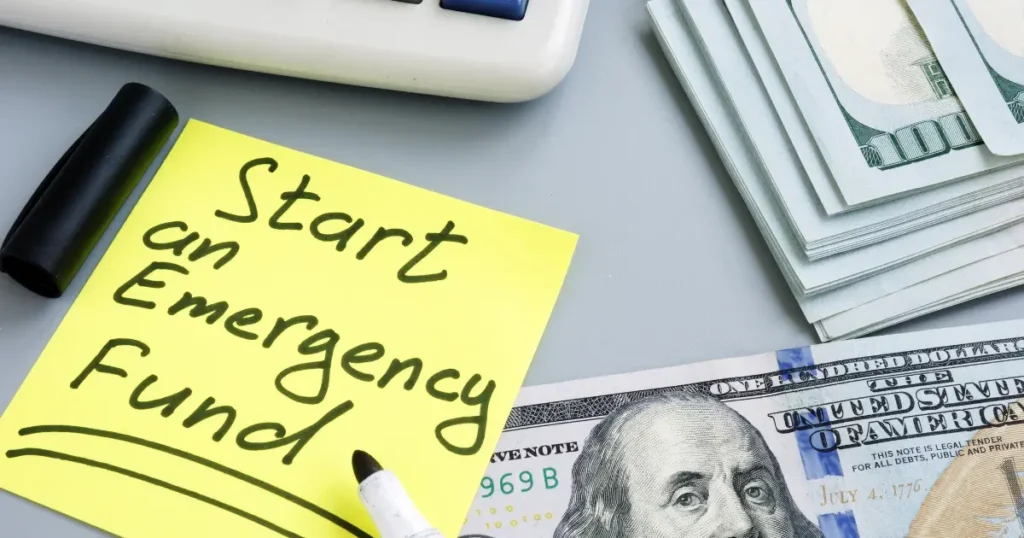
The $1,000 Starter Emergency Fund: Why You Need It and How to Build It

Most people are one $500 emergency away from complete financial collapse. A broken car, a tooth infection, or losing your job can destroy months of progress if you have no savings.

$1,000 in savings prevents this collapse.

This guide explains why $1,000 is the magic number, the psychology behind financial stability, and step-by-step plans to build it—even on a tight income.


Why Exactly $1,000?

Most Emergencies Cost $500-1,500

Car repairs: $400-800
Medical/dental emergencies: $300-600
Lost job (need first/last/deposit for new place): $1,200-2,000
Replace broken phone: $200-400
Emergency travel (family emergency): $300-800

$1,000 covers most single emergencies without destroying your life.

It won’t cover everything, but it’s enough to handle the majority of crises that derail people living paycheck-to-paycheck.


The Domino Effect of No Savings

Here’s what happens without $1,000 saved:

Day 1: Car breaks down ($600 repair)
You have $200 in your account.

Day 2: Can’t afford repair
You miss work because you can’t get there.

Day 5: Miss 3 days of work
Lost wages: $300-500.

Day 7: Can’t pay rent
Now you’re short on rent by $400-600.

Day 14: Eviction notice
Landlord files for eviction.

Day 30: Lose housing
Now you’re homeless, which makes finding a job nearly impossible.

Total damage from a $600 car repair: Lost job, lost housing, financial collapse.

With $1,000 saved:
Fix the car. Go to work. Pay rent. Crisis handled.


The Psychology of Financial Stability

Why Broke People Stay Broke

Without savings, you make desperate decisions:

  • Taking payday loans at 400% APR
  • Overdrafting your account ($35 fee per transaction)
  • Skipping bills to cover emergencies (which leads to late fees and shutoffs)
  • Accepting predatory loan terms
  • Taking the first job offer even if it’s terrible (because you need money NOW)

With $1,000 saved, you make rational decisions:

  • You can afford to fix your car instead of taking a payday loan
  • You can wait for a better job instead of accepting the first minimum-wage offer
  • You can negotiate payment plans instead of panicking
  • You can say “no” to predatory lenders

$1,000 isn’t wealth. It’s breathing room.


The Mental Shift

Before $1,000:
Every unexpected expense feels catastrophic. You’re constantly stressed. You avoid checking your bank account.

After $1,000:
Unexpected expenses are annoying, not life-ending. You sleep better. You stop making desperate financial decisions.

This is the real value of an emergency fund: peace of mind and rational decision-making.


How to Build $1,000 (Step-by-Step Plans)

Plan 1: If You Earn $1,500-2,000/Month

Goal: Save $1,000 in 5-6 months

Month 1-2: Save $200/month
Cut one recurring expense:

  • Cancel a subscription ($10-50/month)
  • Stop eating out (save $60-100/month)
  • Sell something you don’t need ($50-200 one-time)

Month 3-4: Save $300/month
Add income:

  • Pick up one extra shift per week (+$100-200/month)
  • Do a side gig (DoorDash, TaskRabbit, yard work)
  • Sell more unused items

Month 5-6: Save $300-400
Combine cuts and extra income:

  • Use tax refund if available
  • Apply overtime if possible
  • One final push to hit $1,000

Total: $1,000 in 5-6 months


Plan 2: If You Earn $1,000-1,500/Month (Tight Budget)

Goal: Save $1,000 in 8-10 months

Save $100-125/month consistently

How to find $100/month:

  • Cook all meals at home (save $40-60)
  • Cancel Netflix/Hulu/subscriptions (save $15-30)
  • Walk or bike instead of Uber (save $20-40)
  • Buy generic brands instead of name brands (save $15-25)

Boost with one-time windfalls:

  • Tax refund
  • Birthday/holiday money
  • Selling items (old phone, clothes, electronics)

Total: $1,000 in 8-10 months


Plan 3: If You’re Broke Right Now (Under $1,000/Month)

Goal: Save $1,000 in 10-15 months

This is hard. But not impossible.

Save $50-75/month

How to find $50:

  • Cut one “luxury” (soda, energy drinks, fast food) = $20-30
  • Buy cheaper groceries (rice, beans, eggs instead of meat) = $15-25
  • Walk instead of paying for transport when possible = $10-15

Add small income boosts:

  • Donate plasma ($50-100 per week)
  • Odd jobs (Craigslist gigs, yard work, moving help)
  • Return bottles/cans for deposit money (if your state has deposits)
  • Sell items you don’t need

Use every windfall:

  • Tax refund (even small ones)
  • Government stimulus (if/when available)
  • Birthday/holiday money
  • Found money or rebates

Total: $1,000 in 12-15 months

Reality check: This sucks. Saving $50/month when you’re barely surviving is brutal. But the alternative—staying one emergency away from collapse—is worse.


Where to Keep Your $1,000

Separate Savings Account (Best Option)

Why:
Out of sight = less temptation to spend it.

Where to open one:

  • Ally Bank (online, no fees, 4%+ interest)
  • Marcus by Goldman Sachs (online, no fees, 4%+ interest)
  • Local credit union (often no fees, easy access)
  • Chime (online, no fees, auto-save features)

Open an account that’s NOT linked to your debit card. You want it accessible for real emergencies, but not so easy that you spend it on impulse.


High-Yield Savings (If You Have Discipline)

If you can resist touching it, put your $1,000 in a high-yield savings account earning 4-5% interest.

At 4% interest:
$1,000 earns $40/year. Not life-changing, but better than $0.

Popular options:

  • Ally Bank
  • Marcus
  • Capital One 360 Savings

Cash in an Envelope (Last Resort)

Only do this if:

  • You can’t open a bank account (no ID, bad banking history)
  • You live somewhere you trust won’t get robbed

Hide it well. Not in obvious places (under mattress, sock drawer). Think creative—inside books, sealed in containers, etc.

Downside: Cash loses value to inflation and you can’t earn interest. But $1,000 cash is better than $0 saved.


What Counts as an Emergency?

Real Emergencies (Use the $1,000)

✓ Car breaks down and you need it for work
✓ Medical/dental emergency (infection, broken bone)
✓ Lose your job and need deposits for new housing
✓ Essential appliance breaks (fridge, heat in winter)
✓ Legal fees for critical situations


NOT Emergencies (Don’t Touch the $1,000)

✗ Black Friday sale on something you want
✗ Birthday or holiday gifts
✗ Vacation or concert tickets
✗ Upgrading your phone
✗ New clothes (unless for a job interview)
✗ Eating out because you’re tired of cooking

The rule: If it’s not urgent and necessary for survival or income, it’s not an emergency.


What to Do After You Hit $1,000

Step 1: Celebrate (Seriously)

You did something most Americans can’t do. Over 60% of people don’t have $1,000 saved.

Take a moment and acknowledge you now have financial breathing room.


Step 2: Leave It Alone

Don’t immediately spend it.
The temptation is real. Resist it.

Your $1,000 is insurance, not a shopping fund.


Step 3: Build to $2,000-3,000 (Eventually)

Once you’ve had $1,000 for 3-6 months and haven’t touched it, start building toward $2,000.

Why:
$2,000-3,000 covers multiple smaller emergencies or one larger crisis.

How:
Same strategy—cut expenses, add income, save $100-300/month.


Step 4: Address High-Interest Debt

Once you have $1,000-2,000 saved, focus on paying off:

  • Credit cards (15-25% interest)
  • Payday loans (300-400% APR)
  • High-interest personal loans

Why wait until after $1,000?
Because paying off debt first leaves you with $0 savings. Then the next emergency forces you back into debt.

$1,000 saved + paying off debt = financial progress without collapsing.


Common Obstacles (And How to Handle Them)

“I Can’t Save $100/Month”

Then save $50. Or $25. Or $10.

$10/month = $120/year. In 8 years, you’ll have $1,000.

That’s not ideal, but it’s better than $0.

The goal isn’t speed—it’s consistency.


“Every Time I Save, an Emergency Happens”

That’s the point of the emergency fund.

Yes, emergencies will happen. That’s why you’re saving.

Eventually, you’ll have enough saved that one emergency doesn’t wipe you out completely.


“I’ll Never Make Enough to Save”

If you earn $1,000/month, saving $1,000 feels impossible.

But here’s the math:

  • Save $50/month = $600/year
  • Add $200 tax refund = $800/year
  • Sell $200 worth of stuff = $1,000 in year 1

It’s slow. But it’s possible.


“What If I Need to Spend It Before I Hit $1,000?”

Then spend it.

If your car breaks down and you’ve saved $400, use it. Then start rebuilding.

Partial savings > no savings.

Even $300 saved prevents you from taking a payday loan or overdrafting your account.


The Psychology of Financial Security

What Changes When You Have $1,000 Saved

Before:

  • Constant anxiety about money
  • Every financial decision feels desperate
  • Afraid to check bank account
  • Can’t sleep because of money stress

After:

  • Still stressed about money, but not panicked
  • Can make rational decisions instead of desperate ones
  • Emergencies are annoying, not catastrophic
  • Sleep slightly better

$1,000 doesn’t make you rich. It makes you stable.


Why People Resist Saving

“I’ll save later when I make more money.”
No, you won’t. Expenses expand to match income. Start now.

“I deserve to enjoy my money.”
You do. But you also deserve to not panic when your car breaks down.

“Saving $50/month won’t make a difference.”
$50/month = $600/year = enough to prevent one major crisis.

The reality: Saving feels like sacrifice in the moment. But financial collapse feels worse.


The Bottom Line

Most financial advice says “save 3-6 months of expenses.”
That’s $9,000-18,000 for most people. Completely unrealistic when you’re broke.

$1,000 is realistic. And it’s enough to prevent most disasters.

Your goal:

  • Save $100-300/month however you can
  • Keep it in a separate account
  • Only touch it for real emergencies
  • Rebuild it immediately after using it

This isn’t about getting rich. It’s about not being one crisis away from homelessness.

$1,000 in savings = financial stability.
$0 in savings = one emergency away from collapse.

Start today. Even if it’s just $10.

You’ve got this.

Scroll to Top